
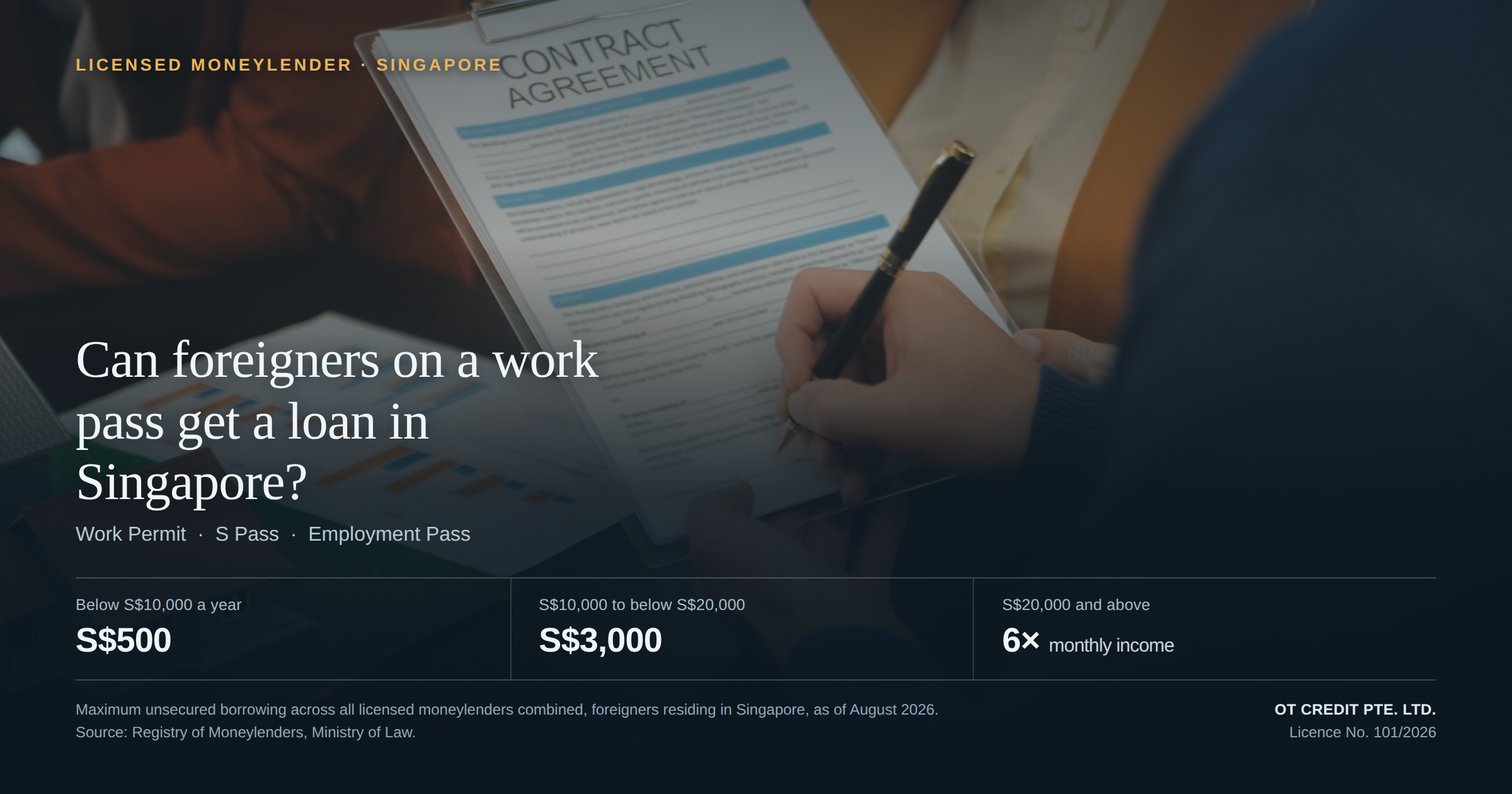
Foreigners on a work pass can borrow from a licensed moneylender in Singapore. Eligibility turns on residency and income rather than pass type, so Work Permit, S Pass and Employment Pass holders come under the same rules. As of August 2026, a foreigner residing in Singapore can hold at most S$500 in unsecured loans across all licensed moneylenders combined if annual income is below S$10,000, S$3,000 from S$10,000 to below S$20,000, and six times monthly income at S$20,000 or more. Existing loans are checked through the Moneylenders Credit Bureau (MLCB). Approval is subject to the lender’s assessment.
Can foreigners on a work pass get a loan in Singapore?
Foreigners on a work pass can borrow from a licensed moneylender in Singapore. What matters is that you reside here and can show income and repayment ability — not whether the card in your wallet says Work Permit, S Pass or Employment Pass. The same borrowing caps, interest caps and contract rules apply across all three. Approval is subject to the lender’s assessment of your income, existing loans, and repayment ability.
Licensed moneylenders in Singapore are regulated by the Registry of Moneylenders, Ministry of Law (MinLaw), under the Moneylenders Act. A licensed moneylender is not a bank, and it is not regulated by the Monetary Authority of Singapore.
Where pass holders differ is in how much they can borrow, since that follows income.
How much can a work pass holder borrow, and how is the limit calculated?
As of August 2026, a foreigner residing in Singapore can hold at most S$500 in unsecured loans across all licensed moneylenders combined if annual income is below S$10,000; S$3,000 if annual income is from S$10,000 to below S$20,000; and six times monthly income if annual income is S$20,000 or more. Secured loans have no cap. These limits are set under the Moneylenders Act and are checked through the Moneylenders Credit Bureau (MLCB) when you apply.
| Annual income | Singapore Citizens and PRs | Foreigners residing in Singapore |
| Below S$10,000 | S$3,000 | S$500 |
| S$10,000 to below S$20,000 | S$3,000 | S$3,000 |
| S$20,000 and above | 6× monthly income | 6× monthly income |
| Secured loans (any income) | No cap | No cap |
The cap is aggregate, not per lender. If you already owe S$1,000 and your cap is S$3,000, the headroom left across every other licensed moneylender is S$2,000.
Is the limit based on my basic salary, or does overtime count?
Your cap is set by the income band you fall into, and OT Credit asks for three months’ payslips, so the figure comes from what those payslips show. Whether overtime and allowances count towards the statutory definition of income is a separate question — one that matters most where overtime is a large share of take-home pay.
What documents do I need if I have no CPF contributions or local payslip?
As of August 2026, OT Credit’s published requirements for pass holders are a passport, a valid pass, three months’ payslips, a letter of employment, an employer confirmation letter, and proof of local address. A CPF contribution statement is not stated as mandatory for pass holders, and face-to-face verification takes place before money is released.
| Document | Position |
| Passport | Required |
| Valid S Pass or Employment Pass | Required |
| Three months’ payslips | Required |
| Letter of employment | Required |
| Employer confirmation letter | Required |
| Local address or billing proof | Required |
| CPF contribution statement | Not stated as mandatory for pass holders |
| Face-to-face verification | Yes, before money is released |
If any part of the paperwork is unclear, the lender is required to explain the contract terms in a language you understand before you sign.
What does the loan actually cost, and what is the most I could ever repay?
As of August 2026, a licensed moneylender in Singapore may charge interest of at most 4% per month, late interest of at most 4% per month on the amount repaid late, a late fee of at most S$60 for each month of late repayment, and an administrative fee of at most 10% of the principal at the time the loan is granted. Court-ordered legal costs are the only other permitted charge. Interest, late interest, the administrative fee and late fees combined can never exceed the loan principal.
That last rule sets a hard ceiling. On a S$1,500 loan, total charges can never exceed S$1,500, so the most you could ever repay in total is S$3,000. The rate you are quoted within the 4% cap depends on the lender’s assessment.
Is the 4% charged on the full amount or on what is left?
Interest is computed on the remaining principal after repayments, not on the original amount borrowed. As of August 2026, the 4% monthly maximum applies to the balance still outstanding, so the interest charged falls each month as principal is repaid.
Worked example: a S$1,500 loan repaid over six months
The figures below illustrate the statutory maximums as of August 2026 applied to equal principal repayments of S$250 a month. They are an illustration, not a quotation, and not an offer.
| Month | Principal outstanding | Interest at 4% | Principal repaid | Total paid that month |
| 1 | S$1,500.00 | S$60.00 | S$226.14 | S$286.14 |
| 2 | S$1,273.86 | S$50.95 | S$235.19 | S$286.14 |
| 3 | S$1,038.67 | S$41.55 | S$244.60 | S$286.14 |
| 4 | S$794.07 | S$31.76 | S$254.38 | S$286.14 |
| 5 | S$539.69 | S$21.59 | S$264.55 | S$286.14 |
| 6 | S$275.14 | S$11.01 | S$275.14 | S$286.14 |
| Total | — | S$216.86 | S$1,500.00 | S$1,716.86 |
Add the maximum administrative fee of 10% of principal — S$150 on S$1,500 — and total charges come to S$360, inside the S$1,500 ceiling. Ask the lender whether that fee is deducted from the amount disbursed or added to your repayment schedule before you sign.
What happens to my loan if my pass is not renewed, I am let go, or I leave Singapore?
Your work pass and your loan are separate arrangements. A loan from a licensed moneylender in Singapore is an agreement between you and the lender, so the balance remains payable if your pass is not renewed, your employment ends, or you leave the country. What a lender may charge you if payments stop is capped. As of August 2026, that is late interest of at most 4% per month on the amount repaid late, a late fee of at most S$60 for each month of late repayment, and court-ordered legal costs. Nothing else is permitted, and total charges still cannot exceed the principal.
Loans from licensed moneylenders are checked against the MLCB, so an outstanding balance is visible when you next apply.
There is no authoritative MinLaw, ICA or MOM source stating that an outstanding loan from a licensed moneylender, by itself, automatically prevents a person from leaving or re-entering Singapore, obtaining or renewing a work pass, or applying for Singapore Permanent Residence. Those decisions are governed by the relevant ICA and MOM requirements. Do not assume that an ordinary licensed moneylender debt creates an immigration restriction.
OT Credit does not publish a separate process for repayments made from outside Singapore; its published options are GIRO, funds transfer, cash and over-the-counter payment. Contact OT Credit before you leave to confirm how your scheduled repayments can be maintained.
Bank, licensed moneylender, or neither — which is realistic on my income?
Three routes exist, and borrowing is not automatically the right one. Banks and licensed moneylenders are different categories of institution, with different regulators and different ways of expressing cost.
| Licensed moneylender | Bank | |
| Regulator | Registry of Moneylenders, Ministry of Law | Monetary Authority of Singapore |
| Eligibility | The lender’s assessment of income, existing loans and repayment ability, within the statutory borrowing caps | Bank-specific credit assessment, including income and existing commitments |
| Cost | Monthly interest capped at 4%, with the other permitted charges listed above | Advertised rate plus the Effective Interest Rate (EIR) |
MoneySense advises comparing loan packages using the Effective Interest Rate rather than the advertised rate.
The third route is not borrowing at all. Depending on the situation, that can mean employer assistance, a payment plan with the party you owe, or help from a debt-help organisation such as Credit Counselling Singapore, which handles cases that also involve bank debts.
If the repayment plan only works when nothing goes wrong, it does not work.
Is it legal for a licensed moneylender to text me or leave a flyer at my dormitory?
No. Licensed moneylenders in Singapore may advertise through three channels only: business or consumer directories in print or online, their own website, and advertisements within or on the exterior of their business premises. Every other channel is prohibited, including SMS, WhatsApp, other unsolicited messages, and flyers. That has been the position under the Registrar’s Directions on Advertising and Marketing Activities since 1 November 2011.
So a loan offer that arrives by message or appears as a flyer at your dormitory is not a legitimate approach, even when the name on it belongs to a real licensee.
You can check any moneylender against MinLaw’s list of licensed moneylenders in Singapore. If something does not match, or a lender asks for your SingPass credentials or wants to keep your identity documents, contact the Registry of Moneylenders at 1800-2255-529, or the Police X-Ah-Long hotline at 1800-924-5664 for unlicensed moneylending.
Before you borrow. Borrow only what your repayment plan can carry, and only for a need you have costed out. If you are already borrowing more than you can manage, the MLCB operates a voluntary self-exclusion scheme that blocks new unsecured loans from licensed moneylenders — a minimum of one or two years for Citizens and PRs, and two years for foreigners, with debt consolidation loans excepted. The Registry of Moneylenders can be reached at 1800-2255-529.
Frequently asked questions
Do my bank loans and credit cards count towards the licensed moneylender borrowing cap?
No. As of August 2026, bank loans and credit card balances do not count towards the statutory aggregate borrowing cap for licensed moneylenders under Rule 21 of the Moneylenders Rules. That cap covers unsecured loans across all licensed moneylenders combined. Bank debt can still affect a lender’s assessment of your repayment ability.
What must a licensed moneylender give me in writing, and does it have to be in a language I understand?
Licensed moneylenders in Singapore must explain the contract terms in a language you understand, give you a copy of the Note of Contract, issue receipts for every repayment, and provide statements of account at least every January and July. These requirements were in force as of August 2026 and apply to all borrowers, including work pass holders.
Can I take loans from two licensed moneylenders at the same time?
You may hold loans from more than one licensed moneylender in Singapore, but the borrowing cap is aggregate. As of August 2026, your unsecured loans across all licensed moneylenders combined cannot exceed the cap for your income tier and residency status. Lenders check your existing loans through the Moneylenders Credit Bureau (MLCB) when you apply.
Is there a fee if I repay early?
As of August 2026, no general early-repayment fee is listed as a permitted charge for non-business loans under the Moneylenders Rules. For business term loans, an agreed early-redemption fee is permitted. OT Credit does not publish an early-repayment policy, so confirm the position in writing before you sign.
If I miss a repayment, what can a licensed moneylender legally charge me?
As of August 2026, a licensed moneylender in Singapore may charge late interest of at most 4% per month on the amount repaid late — not on amounts outstanding but not yet due — plus a late fee of at most S$60 for each month of late repayment. Court-ordered legal costs are the only other permitted charge.
Can a lender hold my passport or work permit card, or ask for my SingPass login?
No. Licensed moneylenders in Singapore may not retain your NRIC or other identity documents, and may not ask for your SingPass login credentials. If a lender does either, you can contact the Registry of Moneylenders at 1800-2255-529, or the Police X-Ah-Long hotline at 1800-924-5664 for unlicensed moneylending.
Sources
- Registry of Moneylenders, Ministry of Law — Guide to borrowing from licensed moneylenders (interest, late interest, fee caps, borrowing caps)
- Registry of Moneylenders, Ministry of Law — List of licensed moneylenders in Singapore
- Singapore Statutes Online — Moneylenders Act and Moneylenders Rules (including Rule 21 on aggregate borrowing caps)
- MoneySense — moneysense.gov.sg (comparing loan packages using the Effective Interest Rate)
- Moneylenders Credit Bureau — mlcb.com.sg
- OT Credit’s published document requirements and repayment options
Figures in this article were verified against the Registry of Moneylenders’ pages in August 2026. Caps, fees and processes can change; re-verify at rom.mlaw.gov.sg before relying on any figure.
OT CREDIT PTE. LTD. — licensed by the Ministry of Law’s Registrar of Moneylenders, Licence No. 101/2026.
If you want to discuss a personal loan, you can reach us through the contact details on our website. Approval is subject to our assessment of your income, existing loans, and repayment ability. Any moneylender’s licence, including ours, can be checked on MinLaw’s list of licensed moneylenders.
