
Grab driver, delivery rider or freelancer? How to prove your income for a loan in Singapore.
Not having a payslip does not rule you out of borrowing in Singapore. Licensed moneylenders in Singapore can assess self-employed income from other records, such as your Notice of Assessment (NOA) from IRAS, your bank statements, and your CPF contributions. OT Credit, for example, asks self-employed applicants to bring their NOA and a few months of bank statements. As of September 2026, the legal borrowing limits depend on your annual income and residency status, and approval is always subject to the lender’s assessment of your income, existing loans, and repayment ability. Licensed moneylenders can lend to gig workers and freelancers Ride-hail drivers, delivery riders, freelancers and commission earners can all apply for a personal loan from a licensed moneylender in Singapore. As of September 2026, the legal borrowing limits are based on annual income and residency status. The rules set no separate limit for self-employed people, so what counts is the income you can document and your ability to repay. Licensed moneylenders are regulated by the Registry of Moneylenders under the Ministry of Law (MinLaw), not by the Monetary Authority of Singapore, and they are not banks. Each lender makes its own assessment. OT Credit says it looks at an applicant’s current income and repayment ability. Platform workers and freelancers start with different paperwork Before gathering documents, it helps to know which group you fall into. Under the Platform Workers Act, in force since 1 January 2025, the Ministry of Manpower (MOM) treats you as a platform worker if you provide ride-hail or delivery services, have a platform work agreement, and are under the platform operator’s management control. Freelancers doing other work, such as tutoring, design or photography, fall outside the Act. The difference shows up in your records. From 1 January 2025, platform operators deduct CPF contributions from platform workers’ earnings. Platform workers therefore receive CPF contribution records, but the type of contribution depends on age and opt-in status. If you were born on or after 1 January 1995, increased CPF contributions are mandatory and go into your Ordinary, Special, or Retirement and MediSave accounts. If you were born earlier, you can opt in to the increased contributions; if you don’t, your platform operator continues making MediSave-only contributions. Platform operators must also give you earnings slips showing the earnings period, the amounts paid and deducted, your CPF contributions, and the net amount paid. Keep them. Whether a particular lender accepts them as proof of income is for that lender to confirm. Your NOA and bank statements carry most of the weight For self-employed applicants, the NOA and bank statements are the core documents. OT Credit asks self-employed applicants for both, and its general requirements mention proof of income such as CPF contributions or bank statements. If clients pay you by PayNow or bank transfer, those payments land in your bank account, which is why a few months of statements matter so much for freelancers. For anything else, such as invoices or earnings slips, ask OT Credit first whether it will accept them. Where to get each record (as of September 2026) Record Issued by Where to get it Notice of Assessment IRAS myTax Portal, where previous tax bills can also be viewed CPF monthly transaction statement CPF Board CPF website, under My Statements then Transaction history, after logging in with Singpass; downloadable as a PDF Platform earnings slip Your platform operator Provided by the operator; Grab drivers can view daily and weekly income statements in the Grab app and download the full statement as a PDF Bank statements Your bank Through your bank Your NOA shows income after expenses, not gross earnings IRAS states that the “Income” amount on the Notice of Assessment is shown after deducting allowable expenses, with trade income shown net of allowable business expenses. So the figure on your NOA can sit well below your gross fares or delivery earnings. The gap can be wide because qualifying drivers and delivery workers can claim a Fixed Expense Deduction Ratio (FEDR) instead of their actual business expenses. As of September 2026, the ratios include 60% for private-hire car and taxi drivers, 35% for delivery by motorcycle, power-assisted bicycle or personal mobility device, 20% for delivery on foot, by public transport or by non-power-assisted bicycle, and 60% for delivery by van. For delivery workers, one of the conditions is annual gross delivery income of S$50,000 or below. Take a private-hire driver who grosses S$45,000 in a year and claims the 60% FEDR. The deduction is S$27,000, so the income shown on the NOA is S$18,000 (an illustration that assumes no other income). As of September 2026, the legal borrowing limit for Singapore Citizens and PRs changes at an annual income of S$20,000. Which income figure a lender uses is for the lender to decide, so check what your own documents show and ask before you apply. Borrowing limits are set by income and residency As of September 2026, if you are a Singapore Citizen or PR earning less than S$20,000 a year, licensed moneylenders in Singapore can lend you at most S$3,000 in unsecured loans in total, across all licensed moneylenders combined. If you earn S$20,000 or more, the cap is six times your monthly income. Foreigners residing in Singapore can borrow up to S$500 if they earn under S$10,000 a year, or S$3,000 if they earn S$10,000 to under S$20,000. Secured loans have no cap. Unsecured borrowing caps across all licensed moneylenders (as of September 2026) Annual income Singapore Citizens and PRs Foreigners residing in Singapore Below S$10,000 S$3,000 S$500 S$10,000 to below S$20,000 S$3,000 S$3,000 S$20,000 and above 6 × monthly income 6 × monthly income Because the cap is a total, applying to several licensed moneylenders at once does not raise it. Under the Moneylenders Act, a licensed moneylender must submit information about your loan application to the credit bureau before granting a loan, and licensed moneylenders can see relevant Moneylenders Credit Bureau (MLCB) loan information, including pending loan applications. Income that rises and
What Licensed Moneylenders Can & Can’t Do in Singapore
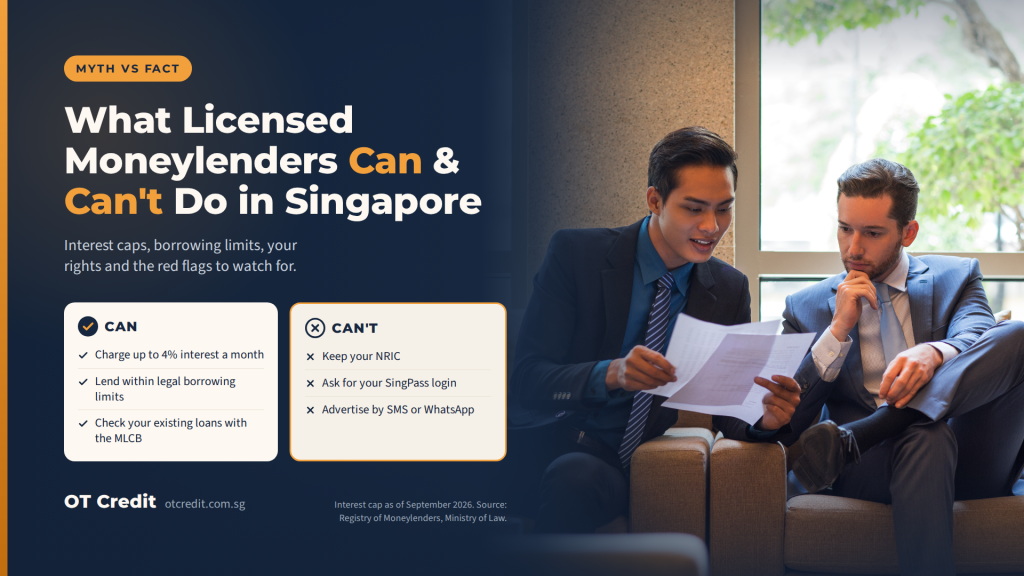
Plenty of people put off borrowing from a moneylender because they aren’t sure what they’re walking into. Will the interest keep climbing? Will someone turn up at the door? Will the lender hold on to their IC? Those worries are understandable, and the rules licensed moneylenders must follow answer most of them. In short, licensed moneylenders in Singapore can grant loans, charge interest and fees up to legal caps, and check your existing loans through the Moneylenders Credit Bureau (MLCB). They cannot keep your NRIC, ask for your SingPass login, advertise through SMS or WhatsApp, or charge more than the Moneylenders Act and Rules allow. This article explains how those rules work in practice, with figures as of September 2026, so you can judge any lender for yourself. The rulebook, and who enforces it A licensed moneylender in Singapore is a business licensed under the Moneylenders Act to lend money to individuals and businesses. It is not a bank, and it is not regulated by the Monetary Authority of Singapore (MAS). Licensed moneylenders answer to the Registry of Moneylenders under the Ministry of Law (MinLaw). The details sit in two pieces of law, the Moneylenders Act 2008 and the Moneylenders Rules 2009, both published on Singapore Statutes Online. The Registrar also issues directions, including on advertising, and the Registry publishes guidance for borrowers. Every licensed moneylender has a licence number and appears on MinLaw’s list of licensed moneylenders. That list comes up again later, because it is the simplest check a borrower can make. What a licensed moneylender is allowed to do Within those rules, a licensed moneylender’s role is fairly narrow. It can assess your application and grant a loan within the legal borrowing limits. It can charge interest and fees, up to the caps set in the Moneylenders Rules. Before lending, it can check how much you already owe other licensed moneylenders through the MLCB. Approval is never a given. It is subject to the lender’s assessment of your income, existing loans, and repayment ability. Licensed moneylenders can also advertise, but only in three places: business or consumer directories, their own website, and within or on the exterior of their approved business premises. If a loan goes unpaid, they can pursue recovery, within guidelines covered further down. Where the law draws the line For most borrowers, the restrictions matter more than the permissions. Licensed moneylenders in Singapore must not keep your NRIC or other identity documents, and must not ask for your SingPass login details. They cannot advertise through SMS, WhatsApp, email, or any channel outside the three permitted ones. As of September 2026, they cannot charge more than 4% interest a month, and the total of interest, late interest, admin fees, and late fees can never exceed the amount you borrowed. Your loan details must also be kept confidential. Many of the fears people bring to a first appointment come from mixing up licensed lenders with loan sharks. Here is how the common myths compare with the rules. Common myths, and what the rules say (as of September 2026) Myth Fact All moneylenders are loan sharks. Licensed moneylenders are licensed and regulated by the Registry of Moneylenders, MinLaw. “Loan shark” is commonly used for people involved in unlicensed moneylending. A moneylender can charge any interest it likes. Interest is capped at 4% a month, computed on the principal remaining after repayments. A lender needs to hold your NRIC as security. A licensed moneylender must not retain your NRIC or other identity documents. Genuine lenders send loan offers by SMS or WhatsApp. Licensed moneylenders may not advertise through SMS or WhatsApp. Pay late, and the charges grow without limit. Interest, late interest, admin fees, and late fees combined can never exceed the principal. A lender can phone your family or boss about the debt. Calls and text messages about the debt should go to the borrower, not a third party. How debt recovery works: home visits, workplace visits and phone calls The thought of a lender turning up at home, or calling the office, stops some people from borrowing at all. The rules here are specific. A licensed moneylender can visit your home or workplace to recover an overdue loan, but only in limited circumstances, and it should not phone or text your family, friends or employer about the debt. Under the Professional Service Handbook (Version 3, April 2026), a home visit should come only after other non-face-to-face methods have been tried, and within specified time limits. A workplace visit is a last resort, after other ways of reaching you have failed. If you are not home, the lender may leave a letter of demand with someone in the household, but should not share your loan details with them. [VERIFY: Professional Service Handbook publisher and link] The cost of borrowing: interest and fee caps Cost is where the rules are most precise. As of September 2026, licensed moneylenders in Singapore can charge at most 4% interest per month, computed on the principal remaining after repayments. Late interest is also capped at 4% a month and applies only to the overdue amount. Late fees are capped at S$60 for each month of late repayment, and the upfront admin fee is capped at 10% of the principal. Combined, these charges can never exceed the amount you borrowed. These caps apply to non-business loans at any income level, secured or unsecured. Business loans follow different fee rules under the Moneylenders Rules. Within the caps, the rate you are quoted depends on the lender’s assessment. Maximum charges on non-business loans (as of September 2026) Charge Legal maximum How it applies Interest 4% per month On the principal remaining after repayments Late interest 4% per month Only on the amount repaid late, not on amounts not yet due Late fee S$60 For each month of late repayment Admin fee 10% of principal Charged when the loan is granted Legal costs Court-ordered only For successful recovery through the courts Total of interest, late
What Can a Moneylender See in Your MLCB Record? Read your own MLCB file
Your MLCB record covers your borrowing from licensed moneylenders in Singapore, not your credit generally. When you apply, a licensed moneylender checks the Moneylenders Credit Bureau (MLCB) to see your outstanding moneylender loans, whether instalments that have fallen due were paid on time, and any pending unsecured applications. It does not hold your bank credit facilities or deposit information. Below: what it shows, how to get your own copy, and how to correct it. What is an MLCB record, and what does a licensed moneylender actually see when they pull it? An MLCB record is the borrowing information held by the Moneylenders Credit Bureau. When you apply to a licensed moneylender in Singapore, the lender sees your outstanding loans with licensed moneylenders, the name of each licensee, whether due instalments were paid on time, and your pending unsecured loan applications (as of September 2026). The borrower-facing version of this information is called the Loan Information Report. What the Loan Information Report contains Under Rule 22F of the Moneylenders Rules 2009, the report includes (as of September 2026): your full name, including aliases your personal identification number your nationality the licensee name for each outstanding loan whether each repayment instalment that has fallen due was paid on time your share of the outstanding loan amount, including interest, late interest and fees the aggregate outstanding secured loan amount, with and without interest, late interest and fees the aggregate outstanding unsecured loan amount, with and without interest, late interest and fees the aggregate amount of pending unsecured loan applications the date and time the report was requested A credit report requested by a lender is a different document under Rule 22E, covering identity, employment status and income over the three months before the month of application. What it does not cover The MLCB holds loans and repayment information from licensed moneylenders. It does not collect borrowers’ bank credit facilities or deposit information, and it does not make lending decisions on a lender’s behalf. Is my MLCB record the same as my Credit Bureau Singapore (CBS) credit report? No. The MLCB and Credit Bureau Singapore are separate reporting systems covering different lenders, and you may have information in both. Requesting one does not give you the other. MLCB CBS What it covers Loans from licensed moneylenders Credit facilities reported by member financial institutions: credit cards, HDB loans, mortgages, motor vehicle loans, personal loans, debt consolidation loans Borrower’s report Loan Information Report Credit Report Operated by Credit Bureau (Singapore) Pte Ltd Credit Bureau (Singapore) Pte Ltd Framework Moneylenders Act 2008 and Moneylenders Rules 2009, administered by the Registry of Moneylenders, Ministry of Law Financial sector credit reporting framework Enquiry line (as of September 2026) 6335 3897 6565 6363 The same company operates both, which is where the confusion starts. Your HDB loan or credit card sits on the CBS side; a licensed moneylender loan sits on the MLCB side. How does what’s in my MLCB record decide how much I can borrow? Unsecured borrowing limits apply across all licensed moneylenders combined, and the MLCB is how a lender sees what you already owe. As of September 2026, Singapore Citizens and PRs earning below S$20,000 a year may borrow up to S$3,000 in total; at S$20,000 or more, the limit is six times monthly income. Foreigners residing in Singapore face lower tiers: S$500 below S$10,000, and S$3,000 from S$10,000 to below S$20,000. Secured loans have no cap. Worked example: how an existing loan reduces what’s left Take a Singapore Citizen earning S$3,000 a month. As of September 2026, six times monthly income gives an aggregate unsecured limit of S$18,000 across all licensed moneylenders combined. If the Loan Information Report shows S$7,000 outstanding with another licensed moneylender, roughly S$11,000 of that S$18,000 remains. A pending S$2,000 application with a third lender also appears on the report, so the next lender sees it before deciding. One detail decides that arithmetic. Under Rule 21, the outstanding amount used in this calculation excludes interest, late interest, and fees — so principal is what counts against your limit, even though the report displays balances inclusive of both (as of September 2026). These figures are arithmetic, not an offer. Approval is subject to the lender’s assessment of your income, existing loans, and repayment ability. Supporting documents such as payslips or an income tax assessment may be required. Can I check my own MLCB report, and how do I get one? Yes. Section 77 of the Moneylenders Act 2008 requires the designated credit bureau to give any person their own Loan Information Report on request. As of September 2026, it must arrive within one business day unless another period is prescribed, and may be delivered as a physical copy for collection, by registered post, or by email. A transaction fee of S$0.50 applies (as of September 2026). The Act does not make Singpass a legal requirement, though the online self-service process may use it for identity verification. Check the MLCB portal for the route that applies to you. How do I read my MLCB report — what does each part mean? Your Loan Information Report covers four things: who you are, what you owe to licensed moneylenders, how those repayments have gone, and what you have applied for but not yet drawn. Two parts are easy to misread. The aggregate secured and unsecured figures are totals across all licensed moneylenders, not the balance with any one lender. The pending unsecured loan applications figure covers applications still in progress — one you forgot about still shows. How long does information stay on my MLCB record, and can I correct anything? The Loan Information Report covers loans not yet fully repaid or terminated, plus pending applications, so a fully repaid loan is not part of the outstanding-loan component. Separately, a licensed moneylender must keep the credit report obtained for a loan for five years after that loan is repaid or the contract is terminated (as of September 2026). That five-year rule is a
Can Work Pass Holders Get a Loan in Singapore?
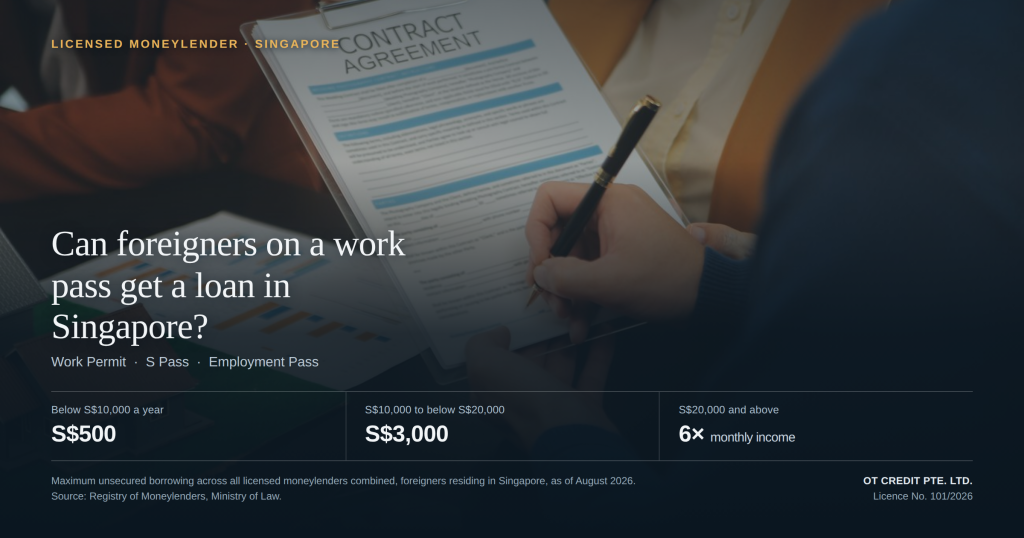
Foreigners on a work pass can borrow from a licensed moneylender in Singapore. Eligibility turns on residency and income rather than pass type, so Work Permit, S Pass and Employment Pass holders come under the same rules. As of August 2026, a foreigner residing in Singapore can hold at most S$500 in unsecured loans across all licensed moneylenders combined if annual income is below S$10,000, S$3,000 from S$10,000 to below S$20,000, and six times monthly income at S$20,000 or more. Existing loans are checked through the Moneylenders Credit Bureau (MLCB). Approval is subject to the lender’s assessment. Can foreigners on a work pass get a loan in Singapore? Foreigners on a work pass can borrow from a licensed moneylender in Singapore. What matters is that you reside here and can show income and repayment ability — not whether the card in your wallet says Work Permit, S Pass or Employment Pass. The same borrowing caps, interest caps and contract rules apply across all three. Approval is subject to the lender’s assessment of your income, existing loans, and repayment ability. Licensed moneylenders in Singapore are regulated by the Registry of Moneylenders, Ministry of Law (MinLaw), under the Moneylenders Act. A licensed moneylender is not a bank, and it is not regulated by the Monetary Authority of Singapore. Where pass holders differ is in how much they can borrow, since that follows income. How much can a work pass holder borrow, and how is the limit calculated? As of August 2026, a foreigner residing in Singapore can hold at most S$500 in unsecured loans across all licensed moneylenders combined if annual income is below S$10,000; S$3,000 if annual income is from S$10,000 to below S$20,000; and six times monthly income if annual income is S$20,000 or more. Secured loans have no cap. These limits are set under the Moneylenders Act and are checked through the Moneylenders Credit Bureau (MLCB) when you apply. Annual income Singapore Citizens and PRs Foreigners residing in Singapore Below S$10,000 S$3,000 S$500 S$10,000 to below S$20,000 S$3,000 S$3,000 S$20,000 and above 6× monthly income 6× monthly income Secured loans (any income) No cap No cap The cap is aggregate, not per lender. If you already owe S$1,000 and your cap is S$3,000, the headroom left across every other licensed moneylender is S$2,000. Is the limit based on my basic salary, or does overtime count? Your cap is set by the income band you fall into, and OT Credit asks for three months’ payslips, so the figure comes from what those payslips show. Whether overtime and allowances count towards the statutory definition of income is a separate question — one that matters most where overtime is a large share of take-home pay. What documents do I need if I have no CPF contributions or local payslip? As of August 2026, OT Credit’s published requirements for pass holders are a passport, a valid pass, three months’ payslips, a letter of employment, an employer confirmation letter, and proof of local address. A CPF contribution statement is not stated as mandatory for pass holders, and face-to-face verification takes place before money is released. Document Position Passport Required Valid S Pass or Employment Pass Required Three months’ payslips Required Letter of employment Required Employer confirmation letter Required Local address or billing proof Required CPF contribution statement Not stated as mandatory for pass holders Face-to-face verification Yes, before money is released If any part of the paperwork is unclear, the lender is required to explain the contract terms in a language you understand before you sign. What does the loan actually cost, and what is the most I could ever repay? As of August 2026, a licensed moneylender in Singapore may charge interest of at most 4% per month, late interest of at most 4% per month on the amount repaid late, a late fee of at most S$60 for each month of late repayment, and an administrative fee of at most 10% of the principal at the time the loan is granted. Court-ordered legal costs are the only other permitted charge. Interest, late interest, the administrative fee and late fees combined can never exceed the loan principal. That last rule sets a hard ceiling. On a S$1,500 loan, total charges can never exceed S$1,500, so the most you could ever repay in total is S$3,000. The rate you are quoted within the 4% cap depends on the lender’s assessment. Is the 4% charged on the full amount or on what is left? Interest is computed on the remaining principal after repayments, not on the original amount borrowed. As of August 2026, the 4% monthly maximum applies to the balance still outstanding, so the interest charged falls each month as principal is repaid. Worked example: a S$1,500 loan repaid over six months The figures below illustrate the statutory maximums as of August 2026 applied to equal principal repayments of S$250 a month. They are an illustration, not a quotation, and not an offer. Month Principal outstanding Interest at 4% Principal repaid Total paid that month 1 S$1,500.00 S$60.00 S$226.14 S$286.14 2 S$1,273.86 S$50.95 S$235.19 S$286.14 3 S$1,038.67 S$41.55 S$244.60 S$286.14 4 S$794.07 S$31.76 S$254.38 S$286.14 5 S$539.69 S$21.59 S$264.55 S$286.14 6 S$275.14 S$11.01 S$275.14 S$286.14 Total — S$216.86 S$1,500.00 S$1,716.86 Add the maximum administrative fee of 10% of principal — S$150 on S$1,500 — and total charges come to S$360, inside the S$1,500 ceiling. Ask the lender whether that fee is deducted from the amount disbursed or added to your repayment schedule before you sign. What happens to my loan if my pass is not renewed, I am let go, or I leave Singapore? Your work pass and your loan are separate arrangements. A loan from a licensed moneylender in Singapore is an agreement between you and the lender, so the balance remains payable if your pass is not renewed, your employment ends, or you leave the country. What a lender may charge you if payments stop is capped. As of August 2026,
How to Apply for a Loan in Singapore Without Hassles

Navigating Singapore’s loan application process as an expat or young professional often feels overwhelming. The process may seem complicated with varying eligibility requirements, complex documents, and a credit system that might work differently than what you’re used to. But don’t worry—with some preparation and guidance, you can secure a loan smoothly and confidently! This guide will explain common mistakes people make when applying for loans in Singapore and how to avoid them. Thus, you can avoid approval delays and focus on achieving financial stability. Mistake 1 – Lack of Understanding of Singapore’s Credit System Applying for a loan in Singapore without understanding its credit system is like sailing without a map. How the Credit System Works Your credit score is a crucial factor when applying for loans. Managed by the Credit Bureau Singapore (CBS), it’s a four-digit score that reflects your likelihood of repaying debts responsibly. The higher your score, the more likely you are to get your loan approved with favorable terms. Lenders use this score to assess your creditworthiness, reviewing your payment history, outstanding debts, length of credit history, and credit utilization. How Expats Can Build Credit If you’re new to Singapore, your credit history might not exist yet—but don’t worry, you can start building it quickly! Get a local credit card and pay off the balance on time each month. Pay your household bills, such as utilities or phone contracts, consistently. To maintain a clean credit record, avoid missing repayments on existing loans or credit agreements. Establishing good credit habits early will open the door to better loan opportunities. Mistake 2 – Not Researching Loan Options Walking into the first lender’s office you find is a rookie mistake, as you could miss out on better deals elsewhere. Loan Types in Singapore You Should Know Personal Loans – Versatile loans that cover various expenses. Car Loans – This is for financing your dream vehicle. Home Loans – Tailored for property purchases. Education Loans – These are for funding tuition fees and other academic expenses. Tips for Comparing Loan Terms When comparing loan options, look beyond just the interest rate. Pay attention to the repayment terms, processing fees, penalties for prepayment, and the Effective Interest Rate (EIR), which gives you the actual loan cost. Use online comparison tools or contact different lenders to discover the best options for your financial needs. Mistake 3 – Submitting Incomplete Documentation One of the most common culprits behind approval delays or rejections is failing to submit the required documents. Checklist of Documents for Loan Applications Here’s what most lenders will ask for when applying for a loan in Singapore: NRIC or Passport Proof of Residence (e.g., utility bills, tenancy agreement) Employment Pass (for expats) Income Proof (e.g., payslips for the last 3 months, CPF contribution statement) Bank Statements (usually the last few months) Organizing Your Paperwork To avoid unnecessary delays, gather all the required documents upfront. Keep scanned copies handy, and double-check with your lender for additional paperwork. Being proactive can save you precious time. Mistake 4 – Ignoring Eligibility Criteria It’s easy to assume a lender will provide a loan just because you apply. However, banks and financial institutions have strict eligibility criteria in Singapore. Key Eligibility Considerations Minimum Income – Most lenders have a minimum annual income requirement. Residency Status—Permanent residents and expats with valid employment passes are usually eligible, but lender criteria may differ. Credit Score – A lower score may limit the amount you can borrow or increase the interest rate. Debt-to-Income Ratio – Lenders may doubt your repayment ability if you carry too much debt compared to your income. Boost Your Eligibility To improve your chances: Maintain a low debt-to-income ratio by paying off outstanding debts before applying. Work on improving your credit score by following step 1. Consider applying for smaller loans initially to build your borrowing history with the lender. Mistake 5 – Not Seeking Professional Advice Navigating the loan market can get tricky, especially considering many variables. If you’re finding it difficult to determine the right loan or feel unsure about the process, seeking professional help is smart. Why Work With a Financial Advisor? Financial advisors can analyze your financial situation, recommend the best loan options, explain industry jargon, and guide you through the application process. They also help you pinpoint red flags in loan agreements to avoid unfavorable terms. Where to Find Reputable Advisors Banks and Licensed Money Lenders – Many offer consultation services. Online Loan Comparison Platforms often partner with financial experts to assist users. Professional Consulting Firms – Look for firms specializing in financial planning to receive tailored advice. Simplify Your Loan Application Applying for a loan in Singapore doesn’t have to be complicated. By understanding the local credit system, researching options, preparing the necessary documents, aligning with eligibility criteria, and seeking professional guidance, you’ll be well-equipped to secure the funding you need. Take the time to evaluate your requirements, stay proactive, and confidently approach the application process. With proper planning, you’ll secure a loan and make a wise financial choice that supports your goals.
A Comprehensive Guide to COE Renewal in Singapore

As a car owner in Singapore, one of the most important things that you need to keep in mind is the validity of your Certificate of Entitlement (COE). It is issued by the Land Transport Authority (LTA) and is required for all vehicles on Singapore’s roads. If your COE is about to expire, you’ll need to go through the process of COE renewal Singapore. Here’s everything you need to know about COE renewal, from eligibility to application process. Eligibility Criteria for COE Renewal To renew your COE, the first thing you need to ensure is that your vehicle is eligible for renewal. The eligibility criteria for COE renewal are as follows: The vehicle must be less than 20 years old The vehicle must be registered in Singapore The vehicle must have a valid insurance policy The vehicle must have passed the relevant vehicle inspection The COE Renewal Process To renew your COE in Singapore, you will need to follow these steps: Obtain a Quotation for COE Renewal Submit Your Application to LTA Pay the COE Renewal Fee Get your New COE and Renewed Road Tax Disc Quotation for COE Renewal Before you apply for COE renewal, you need to obtain a quotation for the renewal fee. You can obtain the quotation from the LTA website or any authorized car dealer. Submit Your Application to LTA You can submit your COE renewal application online or in person at any LTA Customer Service Centre. You must submit your application at least one month before your COE expiry date. You will need to provide the following documents: Your NRIC or passport Your vehicle registration card Your insurance policy Your vehicle inspection certificate Your COE renewal fee quotation Pay the COE Renewal Fee Once your application is approved, you will need to pay the COE renewal fee. You can pay the fee online or in person at any AXS machine or LTA Customer Service Centre. The fee will depend on the prevailing COE prices at the time of renewal. COE renewal in Singapore is a straightforward process that can be completed in a few steps. However, it is important to ensure that you meet the eligibility criteria and have all the necessary documents before submitting your application. Additionally, you should keep in mind the COE renewal fee, which can vary depending on the prevailing COE prices. With this comprehensive guide, you can renew your COE with ease and stay on Singapore’s roads legally.
Why Choose Jurong Money Lenders for Quick Personal Loans

When facing urgent financial requirements, finding a reliable source for quick personal loans becomes crucial. Jurong Money Lenders have established a reputable presence in the financial market and are known for efficiently providing fast personal loans. Choosing the right money lender is paramount in ensuring a smooth borrowing experience. Benefits of Quick Personal Loans Opting for quick personal loans from Jurong Money Lenders has many advantages. One key benefit is the swift and convenient loan application process they offer. In times of urgent financial needs, the speed at which a loan can be obtained is often a deciding factor for many borrowers. Flexible Loan Options Jurong Money Lenders excel in providing a range of flexible loan options tailored to meet diverse financial needs. Whether individuals require a small amount for immediate expenses or a more significant sum for substantial investments, Jurong Money Lenders offer varying loan amounts and repayment terms to accommodate different requirements. Competitive Interest Rates Compared to traditional financial institutions, Jurong Money Lenders offer competitive interest rates on personal loans. Lower interest rates translate to significant cost savings for borrowers over the loan term, making it a financially prudent choice for those seeking affordable financing solutions. Customer-Centric Approach Jurong Money Lenders’ unwavering commitment to a customer-centric approach sets them apart. Their emphasis on personalized service and prioritizing customer satisfaction throughout the loan process ensures that borrowers feel valued and supported every step of the way. This dedication to customer care fosters long-term trust and loyalty. Transparent Terms and Conditions Transparency is key in financial agreements, and Jurong Money Lenders excel at it. They maintain clear and concise terms and conditions for their loans, ensuring that borrowers fully comprehend the agreement before committing. Understanding the terms thoroughly empowers borrowers to make informed decisions regarding their finances. Application Process Simplified Jurong Money Lenders have streamlined the loan application process to make it hassle-free for borrowers. From applying to receiving the loan disbursement, the steps involved are straightforward and efficient. This simplicity saves time and reduces any potential stress associated with applying for a loan. Accessibility and Convenience One of the standout features of Jurong Money Lenders is their accessibility. With several branches throughout Jurong, borrowers can easily visit a nearby office to discuss loan options in person. Many Jurong Money Lenders have also embraced digital advancements, offering online application processes that enhance convenience. This dual approach of physical and online presence ensures that borrowers have multiple avenues to access the financial assistance they need. Personalized Financial Advice Another significant advantage of Jurong Money Lenders is their personalized financial advice. Unlike larger, more impersonal financial institutions, these lenders take the time to understand each borrower’s unique financial situation. By offering tailored advice and loan solutions, they help borrowers make informed decisions that align with their financial goals. This personalized guidance can be especially beneficial for individuals who may not be well-versed in financial matters and need expert advice to navigate their borrowing options. Fast Approval and Disbursement In emergency financial situations, time is of the essence. Jurong Money Lenders understand this urgency and have optimized their processes to ensure quick approval and disbursement of funds. Often, borrowers can receive approval within hours and deposit the funds into their accounts on the same day. This rapid turnaround time can be crucial for meeting pressing financial obligations and provides peace of mind for borrowers needing immediate assistance. Flexible Repayment Plans Jurong Money Lenders also stand out for their flexible repayment plans. Recognizing that every borrower’s financial situation is different, they offer customized repayment schedules that can be tailored to fit individual needs. This flexibility helps borrowers manage their finances more effectively, reducing the risk of default and ensuring they can repay their loans comfortably over time. Building a Positive Credit History Taking a loan from Jurong Money Lenders and repaying it on time can positively impact your credit history. Since these lenders report to credit bureaus, timely repayment of personal loans can improve your credit score. This improvement can benefit future borrowing, as a higher credit score often results in better loan terms and lower interest rates. For individuals looking to rebuild or enhance their creditworthiness, borrowing from Jurong Money Lenders can be a strategic move. Community Engagement Jurong Money Lenders often engage with the local community, supporting various social initiatives and events. This community involvement not only strengthens their ties with residents but also builds a sense of trust and reliability. Borrowers can feel more confident working with lenders who are actively contributing to the betterment of their community, knowing that their lenders have a vested interest in the local area’s wellbeing. Financial Education Resources In addition to providing loans, many Jurong Money Lenders offer financial education resources to their clients. These resources can include workshops, seminars, and online materials designed to help borrowers improve their financial literacy. By equipping borrowers with the knowledge to manage their finances effectively, these lenders empower their clients to make better financial decisions and avoid potential pitfalls associated with borrowing. To Wrap It Up Choosing Jurong Money Lenders for quick personal loans offers many advantages for individuals needing immediate financial assistance. From the speedy application process to the customer-centric approach and competitive interest rates, Jurong Money Lenders stands out as a reliable and trustworthy choice for fulfilling personal financial needs. The benefits of flexible loan options, personalized financial advice, and community engagement further enhance their appeal. Consider the highlighted benefits in this article when seeking efficient and convenient loan solutions. By selecting Jurong Money Lenders, borrowers can expect a seamless borrowing experience, tailored financial solutions, and the peace of mind of working with a trusted local lender.
Key Factors to Keep in Mind Before Getting a Personal Loan

Personal loans can be a valuable financial tool when handled responsibly. Whether you’re a young professional looking to fund major life expenses or a small business owner needing cash flow, personal loans can provide quick access to funds with flexible usage. But before you sign on the dotted line, there are crucial factors to consider to ensure the loan works in your favor, not against it. This guide will walk you through the essentials—understanding personal loans, key factors to weigh before applying, tips for approval, costs, and alternatives—so you can make an informed decision. Understanding Personal Loans What Are Personal Loans? Personal loans are unsecured loans, meaning they’re not backed by collateral. They’re typically used for personal expenses like home renovations, weddings, debt consolidation, or unexpected emergencies. They’re offered by banks, credit unions, licensed moneylenders, or online lenders, and, unlike specific-purpose loans such as home mortgages or car loans, they provide flexibility for how the money is used. Key Terms to Know Understanding the terminology associated with personal loans is essential for making smart decisions. Here’s a quick rundown of terms you’ll come across frequently: APR (Annual Percentage Rate): This is the true annual cost of borrowing, including both the interest rate and additional fees. Principal: The original amount of money borrowed before interest and fees. Loan Tenure: The duration of the loan repayment period. Fees may include origination fees, processing fees, or prepayment penalties. Knowing these terms helps you make apples-to-apples comparisons between lenders. Factors to Consider Before Applying for a Personal Loan Assess Your Financial Situation Before committing to a personal loan, evaluate your financial health. Start by asking yourself: Do I have a steady income source to ensure timely repayments? Have I factored in my other financial obligations, such as rent, bills, and savings? If the monthly repayment stretches your budget too thin, it can lead to long-term stress or default. Understand the Purpose of the Loan Define why you’re taking out the loan. Are you consolidating high-interest debt, covering medical expenses, or funding a business project? Clarifying the purpose will help you determine the loan amount and ensure the benefits outweigh the costs. Research and Compare Lenders Not all lenders are equal. Compare lenders based on the following: Interest rates Origination and late payment fees Customer reviews or testimonials Additional perks (e.g., flexible repayment terms or no penalties for prepayment) Online platforms make it easy to compare multiple lenders at a glance to identify the most favorable terms. Tips for Getting Approved for a Personal Loan Improve Your Credit Score Lenders use credit scores to evaluate your reliability as a borrower. A high credit score increases your chances of approval and could result in lower interest rates. To improve your credit score, pay down existing debt, avoid missed payments, and regularly monitor your credit report for errors. Reduce Your Debt-to-Income Ratio A lower debt-to-income ratio (DTI) signals to lenders that you manage your finances well and are a lower-risk borrower. Aim for a DTI below 36% to enhance your chances of approval. Prepare Necessary Documentation Ensure your application process goes smoothly by having the required documents handy. Typically, lenders will ask for: Proof of income (e.g., pay stubs or tax returns) Bank statements Identification documents (e.g., ID or passport) Only complete applications could ensure approvals and avoid rejection. The Costs of a Personal Loan Common fees While interest is a given, additional fees can drive up the total cost of your loan. Be aware of: Origination Fees: A one-time fee for processing the loan, often ranging from 1% to 5% of the loan amount. Late Fees: Penalties for missed payments can quickly add up. Prepayment Penalties: Fees for paying off your loan early (though many lenders have waived these). Calculating the Total Cost To get a full picture of your loan’s cost, use an online loan calculator to factor in the interest rate, loan tenure, and fees. This will help you ensure that the monthly repayments fit into your budget. Alternatives to Personal Loans While personal loans can be helpful, they’re not always your best option. Explore alternatives such as: Credit Cards: Credit cards with low-interest promotional rates could be more cost-effective for minor or short-term expenses. Home Equity Loans: These secured loans often offer lower interest rates than personal loans. Borrowing from Friends or Family: While trickier to negotiate, this could save you from incurring interest and fees. However, carefully consider the impact of these alternatives on your financial future. Making the Right Choice Taking out a personal loan is no small decision. Carefully weigh your options, crunch the numbers, and consider both short-term needs and long-term impacts. Remember the words of financial expert Dave Ramsey, who advises, “A budget is telling your money where to go instead of wondering where it went.” Apply this mentality to personal loans, ensuring every borrowed penny serves a clear purpose. By evaluating your financial situation, improving your creditworthiness, and examining alternatives, you’ll get approved for the right loan and set yourself on a solid path toward financial success. Unlock Your Financial Potential with Us Today! Are you ready to make a smart financial move? Whether planning a dream wedding, launching a side hustle, or consolidating debt, the right personal loan could be your best ally. Share your experiences or ask questions in the comments below—our experts are here to help!
Common Mistakes to Avoid When Applying for Loans in Singapore

Applying for a loan in Singapore can be essential to achieving your goals, whether funding your dream home, starting a business, or handling unexpected expenses. But navigating the process can sometimes feel overwhelming, especially if you’re unfamiliar with how things work. Many applicants unknowingly make mistakes that hurt their chances of approval or lead to unfavorable terms. To help you avoid these pitfalls, we’ve identified common mistakes people make when applying for loans in Singapore and how to avoid them. Whether you’re a first-time applicant, an expat, or someone needing financial clarity, this guide will ensure your loan application process is smooth and successful. Mistake 1: Not Checking Your Credit Score Lenders evaluate your credit score as one of the most critical factors when assessing your loan application. It provides a snapshot of your financial health and repayment habits. Failing to check your credit score before applying for a loan can result in unpleasant surprises if your score is lower than expected. Why This Matters: Banks and licensed moneylenders in Singapore use your credit score to determine your creditworthiness. A poor credit score may result in higher interest rates or a rejected application. How to Avoid This: You can check your credit report via the Credit Bureau Singapore (CBS). You can request a copy for a small fee; some financial institutions also provide it for free as part of their services. Ensure Your Credit Record Is Accurate by checking for errors or discrepancies in your report. Improve Your Score by paying off outstanding debts and avoiding late payments. Mistake 2: Applying for Too Many Loans at Once When you’re short on funds, the temptation to apply for multiple loans simultaneously can be intense. However, doing so isn’t just ineffective – it can harm your chances of securing your desired loan. Why This Matters: Each loan application triggers a credit inquiry, which may temporarily lower your credit score. Lenders may view multiple loan applications as a red flag, indicating financial instability. How to Avoid This: Research thoroughly before applying. Instead of submitting applications to several lenders simultaneously, shortlist lenders whose terms match your needs. Many banks and lending platforms in Singapore provide online loan eligibility tools to help you determine whether you’re likely to qualify for a specific loan. Apply for only one loan at a time to safeguard your credit score. Mistake 3: Providing Inaccurate Information Submitting inaccurate or incomplete information on your loan application is a surefire way to delay approval. Worse, it could lead to outright rejection or even legal consequences if the inaccuracies appear intentional. Why This Matters: Lenders use your submitted details to calculate your eligibility and assess your loan repayment ability. Even minor inconsistencies can hold up the process. How to Avoid This: Please provide accurate details about your income, employment status, and financial commitments. Please double-check your application before submitting it. Be transparent about outstanding loans or liabilities; lenders can access these details during verification. Ensure that all supporting documents (e.g., payslips, tax returns, or bank statements) are up-to-date and accurate. Mistake 4: Ignoring the Fine Print The terms and conditions buried in your loan agreement can significantly impact your repayment experience. Skimming over the fine print might mean committing to unfavorable terms without realizing it. Why This Matters: Hidden costs like early repayment fees, processing charges, or high-interest rates can catch you by surprise later. Automatic clauses like rollover terms may lead to unexpected additional charges. How to Avoid This: Please read the loan agreement thoroughly, paying close attention to fees, interest rates, repayment schedules, and penalties. If something isn’t clear, ask the lender for clarification before signing. Seek expert advice. Engage a financial advisor or consult free online resources to help you evaluate the terms. Mistake 5: Not Comparing Loan Options Not all loans are created equal. While convenience may tempt you to go with the first lender you come across, this approach can cost you in the long run. Why This Matters: Different lenders offer varying interest rates, repayment tenures, and benefits. How to Avoid This: Compare rates from multiple licensed moneylenders or banks in Singapore. Use online comparison platforms to streamline your research. Consider the interest rate and other terms, such as early repayment, processing fees, and loan tenure. Look for special deals for first-time borrowers or expats (if applicable). Many lenders in Singapore offer promotional rates or perks for specific groups. Pro Tip for Expats in Singapore: Some expats make the mistake of assuming their home country’s financial practices apply everywhere. It’s essential to familiarize yourself with loan regulations in Singapore, such as the Monetary Authority of Singapore’s guidelines on borrowing limits and interest rates for licensed lenders. Final Words for a Successful Loan Application When managed carefully, taking a loan can be a smart financial move that helps you accomplish your goals. However, small mistakes during the application process can lead to significant setbacks. That’s why avoiding common missteps like ignoring your credit score, neglecting loan offers comparison, or providing inaccurate information is essential. If you’re unsure about your loan choices or need further guidance, remember that you don’t have to go through the process alone. With proper preparation and informed decisions, getting approved for a loan in Singapore can be a straightforward, rewarding experience. Start your loan application on the right foot today by researching trusted financial institutions, reviewing your eligibility, and comparing your options. Your financial success begins with the right decision.
Foreigner Loan in Singapore: A Comprehensive Guide

Are you considering a foreigner loan in Singapore to ease your financial burden? Even with inflation slowing down, many locals and expats still struggle with high living costs. Housing expenses are particularly daunting. Expats often face soaring rents, which makes managing finances challenging. This is where foreigner loans in Singapore come into play. These loans can provide crucial financial support. However, it’s essential to understand the details before diving in. In this guide, we’ll explore various aspects of foreigner loans in Singapore. We’ll discuss the types of loans available, eligibility criteria, and interest rates. By the end, you’ll have a clear understanding of how to navigate this financial tool effectively. What is a Foreigner Loan? Foreigners often face challenges when trying to secure loans in Singapore. Without a local credit history, banks and traditional financial institutions are hesitant to approve their loan applications. This makes it extremely difficult for expats to access the funds they need. Fortunately, licensed money lenders provide a solution. They offer foreigner loans in Singapore, which allow expats to obtain financing by simply meeting the necessary requirements. One such licensed money lender is OT Credit Pte Ltd. We specialize in providing personal loans, business loans, and cash advances. Our transparent processes and quick approval times make us a reliable choice for foreigners needing financial support. Personal loans for foreigners are important, especially since newcomers to Singapore typically have limited financial resources. Upon arrival, they often need to pay several months’ rent in advance and a deposit to secure accommodation. Foreigner loans provide these individuals with the financial support needed to establish themselves, and cover essential expenses in their new home. Who Can Get a Foreigner Loan in Singapore? Various financial institutions and legal money lenders, such as OT Credit Pte Ltd, offer loans specifically designed for non-residents. These foreigner loans have different terms and criteria compared to those for Singapore citizens and permanent residents. What Are the Basic Requirements? To obtain a foreigner loan in Singapore, applicants generally need to meet the following criteria: Just like with any other type of loan, the specific documents required for a foreigner loan can vary depending on the lender. However, there are some common documents that are typically needed: A valid Singapore Work Pass, such as an E-pass or S-pass Proof of stable or full-time employment in Singapore Proof of being at least 21 years old (legal age) Evidence of residency, such as a rental contract or utility bills Bank statements showing active transactions for the past three months Recent payslips (usually from the past three months) from your current job Can LTVP Holders Apply for Loans? LTVP holders can apply for unsecured loans in Singapore. To qualify, they may need to provide additional documentation, such as proof of their relationship to a Singapore citizen or permanent resident. Who Offers Foreigner Loans in Singapore? When seeking a foreigner loan in Singapore, it is advisable to trust banks and licensed money lenders. These institutions are legally registered and operate under strict regulations, ensuring your loan application is safe from threats or scams. If a bank rejects your loan application, consider applying to licensed money lenders and other financial institutions that are also licensed. To ensure the legitimacy of a lender, you can verify their status through the Registry of Moneylenders. It’s crucial to avoid rushing into a loan application, even if you urgently need funds. Choosing the right lender is essential to avoid potential threats or falling deeper into debt. Legal money lenders in Singapore provide a secure and reliable option for foreigners needing financial aid in Singapore. Features of Foreigner Loans from Licensed Money Lenders in Singapore Licensed money lenders in Singapore offer foreigner loans with several attractive features: Interest Rate: The interest rate for these loans ranges from 1% to 4%. Loan Amount: You can borrow up to six times your monthly income. Loan Tenure: The repayment period can be up to 12 months. The loan amount you can qualify for also depends on your annual income as a foreigner residing in Singapore: For Annual Income Less Than $10,000: You can borrow up to $500. For Annual Income Between $10,000 and $20,000: You can borrow up to $3,000. For Annual Income of $20,000 or More: You can borrow up to six times your monthly income. By working with a licensed money lender, foreigners in Singapore can access necessary financial support with clear terms and reasonable interest rates. Are Moneylenders in Singapore Safe to Borrow From? When considering a foreigner loan in Singapore, it’s crucial to ensure you borrow only from legal money lenders. The government has stringent regulations in place to prevent illegal money lending, but such activities can still occur. It is essential to take steps to protect yourself by verifying the legitimacy of the lender. Importance of Licensed Money Lenders All money lenders in Singapore must be licensed to operate legally. Licensed money lenders must pass specific tests and receive training to meet government standards. This ensures they follow ethical practices and provide safe lending services. How to Verify a Licensed Money Lender Get Money Lender Reviews If you’ve been in Singapore for a while, you likely have friends or colleagues who can recommend licensed money lenders. Personal recommendations can provide valuable insights. Additionally, consider looking up reviews and recommendations online. Check the Registry The Registry of Moneylenders in Singapore maintains an updated list of all legal money lenders. This list is refreshed monthly, so you can be confident that the information is current. Ensure the money lender you are considering is on this list. Verify Their License and Certificate Licensed money lenders in Singapore are issued a license number and registered with the Association of Moneylenders. Ask to see their license number and cross-check it with the Registry to confirm its validity. Visit Their Website A legitimate money lender will have a professional website. Verify that the information on the website matches what you have been told and aligns with the standards set by