
Plenty of people put off borrowing from a moneylender because they aren’t sure what they’re walking into. Will the interest keep climbing? Will someone turn up at the door? Will the lender hold on to their IC? Those worries are understandable, and the rules licensed moneylenders must follow answer most of them.
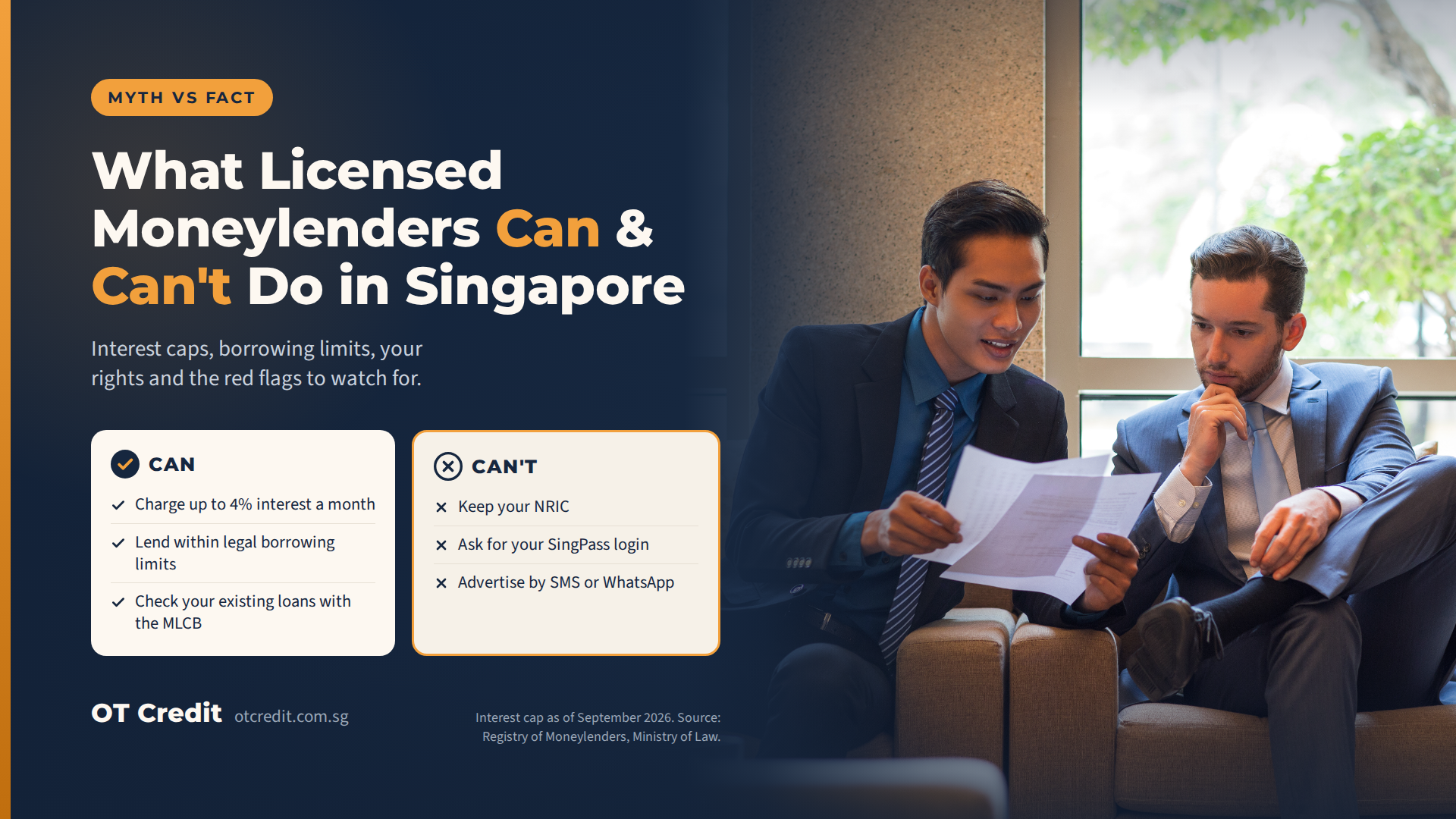
In short, licensed moneylenders in Singapore can grant loans, charge interest and fees up to legal caps, and check your existing loans through the Moneylenders Credit Bureau (MLCB). They cannot keep your NRIC, ask for your SingPass login, advertise through SMS or WhatsApp, or charge more than the Moneylenders Act and Rules allow. This article explains how those rules work in practice, with figures as of September 2026, so you can judge any lender for yourself.
The rulebook, and who enforces it
A licensed moneylender in Singapore is a business licensed under the Moneylenders Act to lend money to individuals and businesses. It is not a bank, and it is not regulated by the Monetary Authority of Singapore (MAS). Licensed moneylenders answer to the Registry of Moneylenders under the Ministry of Law (MinLaw).
The details sit in two pieces of law, the Moneylenders Act 2008 and the Moneylenders Rules 2009, both published on Singapore Statutes Online. The Registrar also issues directions, including on advertising, and the Registry publishes guidance for borrowers. Every licensed moneylender has a licence number and appears on MinLaw’s list of licensed moneylenders. That list comes up again later, because it is the simplest check a borrower can make.
What a licensed moneylender is allowed to do
Within those rules, a licensed moneylender’s role is fairly narrow. It can assess your application and grant a loan within the legal borrowing limits. It can charge interest and fees, up to the caps set in the Moneylenders Rules. Before lending, it can check how much you already owe other licensed moneylenders through the MLCB.
Approval is never a given. It is subject to the lender’s assessment of your income, existing loans, and repayment ability.
Licensed moneylenders can also advertise, but only in three places: business or consumer directories, their own website, and within or on the exterior of their approved business premises. If a loan goes unpaid, they can pursue recovery, within guidelines covered further down.
Where the law draws the line
For most borrowers, the restrictions matter more than the permissions. Licensed moneylenders in Singapore must not keep your NRIC or other identity documents, and must not ask for your SingPass login details. They cannot advertise through SMS, WhatsApp, email, or any channel outside the three permitted ones. As of September 2026, they cannot charge more than 4% interest a month, and the total of interest, late interest, admin fees, and late fees can never exceed the amount you borrowed. Your loan details must also be kept confidential.
Many of the fears people bring to a first appointment come from mixing up licensed lenders with loan sharks. Here is how the common myths compare with the rules.
Common myths, and what the rules say (as of September 2026)
| Myth | Fact |
|---|---|
| All moneylenders are loan sharks. | Licensed moneylenders are licensed and regulated by the Registry of Moneylenders, MinLaw. “Loan shark” is commonly used for people involved in unlicensed moneylending. |
| A moneylender can charge any interest it likes. | Interest is capped at 4% a month, computed on the principal remaining after repayments. |
| A lender needs to hold your NRIC as security. | A licensed moneylender must not retain your NRIC or other identity documents. |
| Genuine lenders send loan offers by SMS or WhatsApp. | Licensed moneylenders may not advertise through SMS or WhatsApp. |
| Pay late, and the charges grow without limit. | Interest, late interest, admin fees, and late fees combined can never exceed the principal. |
| A lender can phone your family or boss about the debt. | Calls and text messages about the debt should go to the borrower, not a third party. |
How debt recovery works: home visits, workplace visits and phone calls
The thought of a lender turning up at home, or calling the office, stops some people from borrowing at all. The rules here are specific. A licensed moneylender can visit your home or workplace to recover an overdue loan, but only in limited circumstances, and it should not phone or text your family, friends or employer about the debt.
Under the Professional Service Handbook (Version 3, April 2026), a home visit should come only after other non-face-to-face methods have been tried, and within specified time limits. A workplace visit is a last resort, after other ways of reaching you have failed. If you are not home, the lender may leave a letter of demand with someone in the household, but should not share your loan details with them. [VERIFY: Professional Service Handbook publisher and link]
The cost of borrowing: interest and fee caps
Cost is where the rules are most precise. As of September 2026, licensed moneylenders in Singapore can charge at most 4% interest per month, computed on the principal remaining after repayments. Late interest is also capped at 4% a month and applies only to the overdue amount. Late fees are capped at S$60 for each month of late repayment, and the upfront admin fee is capped at 10% of the principal. Combined, these charges can never exceed the amount you borrowed.
These caps apply to non-business loans at any income level, secured or unsecured. Business loans follow different fee rules under the Moneylenders Rules. Within the caps, the rate you are quoted depends on the lender’s assessment.
Maximum charges on non-business loans (as of September 2026)
| Charge | Legal maximum | How it applies |
|---|---|---|
| Interest | 4% per month | On the principal remaining after repayments |
| Late interest | 4% per month | Only on the amount repaid late, not on amounts not yet due |
| Late fee | S$60 | For each month of late repayment |
| Admin fee | 10% of principal | Charged when the loan is granted |
| Legal costs | Court-ordered only | For successful recovery through the courts |
| Total of interest, late interest, late fees and admin fee | Cannot exceed the principal | Court-ordered legal costs sit outside this cap |
What a S$3,000 loan can cost at most
Caps are easier to judge with numbers attached.
Illustrative, at maximum legal rates; your quoted rate depends on the lender’s assessment.
Suppose you borrow S$3,000 over six months and repay S$500 of principal each month, with interest at the 4% monthly cap as of September 2026.
| Month | Principal at start | Interest (4%) | Principal repaid | Payment |
|---|---|---|---|---|
| 1 | S$3,000 | S$120 | S$500 | S$620 |
| 2 | S$2,500 | S$100 | S$500 | S$600 |
| 3 | S$2,000 | S$80 | S$500 | S$580 |
| 4 | S$1,500 | S$60 | S$500 | S$560 |
| 5 | S$1,000 | S$40 | S$500 | S$540 |
| 6 | S$500 | S$20 | S$500 | S$520 |
| Total | S$420 | S$3,000 | S$3,420 |
Add the maximum admin fee of S$300 (10% of S$3,000), and the total cost of this loan is S$720 if every repayment is on time. Because interest is charged only on what is still owed, it falls each month as the principal comes down. A payment a month late can add late interest of up to 4% of the overdue amount, plus a late fee of up to S$60.
However late the repayments, the interest, late interest, late fees and admin fee on this loan can never exceed S$3,000. That puts the legal maximum at S$6,000 in total, before any court-ordered legal costs. It is a ceiling, not a typical outcome.
How much you can borrow
A second set of limits controls how much you can borrow in the first place. As of September 2026, Singapore Citizens and PRs earning less than S$20,000 a year can borrow up to S$3,000 in unsecured loans from licensed moneylenders. Foreigners residing in Singapore can borrow up to S$500 if they earn below S$10,000, or S$3,000 if they earn S$10,000 to below S$20,000. At S$20,000 or more, the cap is six times monthly income. Secured loans have no statutory cap.
Unsecured borrowing caps across all licensed moneylenders (as of September 2026)
| Annual income | Citizens and PRs | Foreigners residing in Singapore |
|---|---|---|
| Below S$10,000 | S$3,000 | S$500 |
| S$10,000 to below S$20,000 | S$3,000 | S$3,000 |
| S$20,000 or more | 6 × monthly income | 6 × monthly income |
These caps are totals across every licensed moneylender you borrow from, not limits per lender, and lenders check what you already owe through the MLCB. They depend on income and residency status, not on whether you are salaried or self-employed.
Telling a licensed moneylender from a loan shark
All of these protections apply only if the lender is actually licensed. To tell a licensed moneylender from a loan shark in Singapore, check the lender’s name, address and licence number against MinLaw’s list of licensed moneylenders. “Loan shark” is commonly used for people involved in unlicensed moneylending. As of September 2026, the Registry warns that unsolicited loan SMSes or calls from unknown sources are likely to be linked to unlicensed moneylending.
A few other signs deserve a second look:
- An unsolicited loan offer by SMS, WhatsApp or another prohibited channel. This is not a permitted way for a licensed moneylender to find borrowers. It may point to unlicensed moneylending, or to a licensed lender breaching the advertising rules.
- A message using a licensed lender’s name. The Registry warns that scammers use SMS or WhatsApp to impersonate licensed moneylenders, so check contact details against the official list.
- A lender that wants to keep your NRIC or asks for your SingPass login.
If you suspect unlicensed moneylending, contact the Police on 999 or 1800-255-0000.
Your protections once you sign
The paperwork is part of your protection. A licensed moneylender in Singapore must explain the loan terms in a language you understand before you sign, and give you a signed copy of the Note of Contract before or when the loan is disbursed. After that, you should receive a receipt for every repayment and a statement of account at least every January and July.
Keep these documents together. If something goes wrong, they are your record of what you agreed to and what you have paid, and you can call the Registry of Moneylenders on 1800-2255-529 if a licensed moneylender breaks the rules.
Before you borrow: a five-point check
Everything above comes down to a few checks you can make at your first appointment:
- Find the lender on MinLaw’s list of licensed moneylenders, and match the name, address and licence number.
- Ask for the monthly interest rate, admin fee and late charges, and compare them with the caps above.
- Make sure the terms are explained in a language you understand before you sign.
- Don’t share your SingPass login, and don’t leave your NRIC with the lender.
- Take your signed copy of the Note of Contract, and keep every receipt.
When borrowing becomes a problem
Sometimes the harder question is whether to borrow at all. If you are struggling to stop taking new loans, you can register with the MLCB’s self-exclusion scheme. As of September 2026, once you are registered, licensed moneylenders in Singapore cannot grant you a new unsecured loan, except a debt consolidation loan. Citizens and PRs choose a minimum period of 1 or 2 years; for foreigners, the minimum is 2 years. You generally cannot withdraw during that period, and the exclusion continues until you withdraw it.
If your debts are already hard to manage, these organizations can help (contact details from the Professional Service Handbook, April 2026):
| Organization | Phone |
|---|---|
| Adullam Life Counseling | 6659 7844 / 9423 8832 |
| Association of Muslim Professionals (AMP) | 6416 3960 |
| Arise2Care Community Services | 6909 0628 |
| Blessed Grace Social Services | 8428 6377 |
| Credit Counseling Singapore (only cases that also involve bank debts) | 6225 5227 / 6338 2663 |
| One Hope Centre | 6547 1011 |
| Silver Lining Community Services | 6749 0400 |
A note on borrowing responsibly. Before you take any loan, work out how each monthly repayment fits into your budget, and borrow only what you can repay on schedule. If repaying one loan would mean taking out another, speak to one of the organizations above first.
Frequently asked questions
What documents do I need to bring to a licensed moneylender?
Documents vary by licensed moneylender and by borrower. OT Credit asks for your NRIC and proof of income, such as recent payslips, CPF contribution records or bank statements. Foreigners need a valid work pass, passport, and proof of local address. Self-employed applicants should bring their Notice of Assessment and recent bank statements. [VERIFY: OT Credit to approve final document list]
Can I borrow from a licensed moneylender if I’m self-employed or earn commission?
Yes, you can apply. As of September 2026, borrowing limits at licensed moneylenders in Singapore depend on annual income and residency status, not on whether you are salaried or self-employed. OT Credit accepts self-employed and commission-based applicants, subject to its assessment. [VERIFY: OT Credit to confirm accepted income documents for commission earners]
Can a licensed moneylender charge extra if I repay my loan early?
As of September 2026, an early repayment fee is not one of the charges licensed moneylenders in Singapore may impose on ordinary non-business loans. Business term loans follow different fee rules. Because interest is computed on the remaining principal, repaying early also reduces the principal on which interest is charged.
Can a licensed moneylender take the admin fee from my loan amount?
As of September 2026, licensed moneylenders in Singapore may charge an upfront admin fee of up to 10% of the principal on a non-business loan, payable when the loan is granted. On a S$3,000 loan, that is at most S$300. [VERIFY: how OT Credit collects the admin fee]
Can I borrow from more than one licensed moneylender at the same time?
Yes, but as of September 2026, the unsecured borrowing caps apply to your total across all licensed moneylenders in Singapore combined, not to each lender separately. A Citizen or PR earning below S$20,000 a year can owe at most S$3,000 in unsecured loans overall. Licensed moneylenders check existing loans through the MLCB.
Will a licensed moneylender loan appear on my credit report?
A loan from a licensed moneylender in Singapore is recorded with the Moneylenders Credit Bureau (MLCB), which is separate from Credit Bureau Singapore (CBS). CBS provides credit reports based on information from banks and major financial institutions, and the MLCB does not collect your bank credit facilities. How a bank assesses your application is a matter for that bank.
You can verify any moneylender’s licence on the Ministry of Law’s list of licensed moneylenders.
Speak to OT Credit
Our office is in Jurong East, near Jurong East MRT, and serves borrowers in Jurong West, Clementi, Boon Lay, Bukit Batok and nearby areas. We explain the terms, fees, and repayment schedule before you decide. Approval is subject to our assessment of your income, existing loans, and repayment ability.
[VERIFY: replace this block with OT Credit’s approved CTA block, character-for-character]
OT CREDIT PTE. LTD.<br> Licensed by the Ministry of Law’s Registrar of Moneylenders (Licence No. 101/2026) [VERIFY: confirm against the current Registry list; the 1 May 2026 list showed 100/2025]<br> 135 Jurong Gateway Road, #01-323, Singapore 600135<br> +65 6292 0119
Sources
- Registry of Moneylenders, Ministry of Law: FAQs on Borrowing From Licensed Moneylenders
- Registry of Moneylenders: List of Licensed Moneylenders in Singapore
- Registry of Moneylenders: Registrar’s Directions on Advertising and Marketing Activities, 1 April 2025
- Singapore Statutes Online: Moneylenders Act 2008 and Moneylenders Rules 2009
- Ministry of Law: MLCB self-exclusion (Ask.gov)
- Moneylenders Credit Bureau (MLCB) · Credit Bureau Singapore (CBS)
- Professional Service Handbook, Version 3, April 2026 [VERIFY: link]
- Singapore Police Force