
The operation went well. Your mum’s home, a bit sore, already asking when she can go back to the market. Then the final bill arrives, and the amount payable is a lot more than anyone in the family had pencilled in.
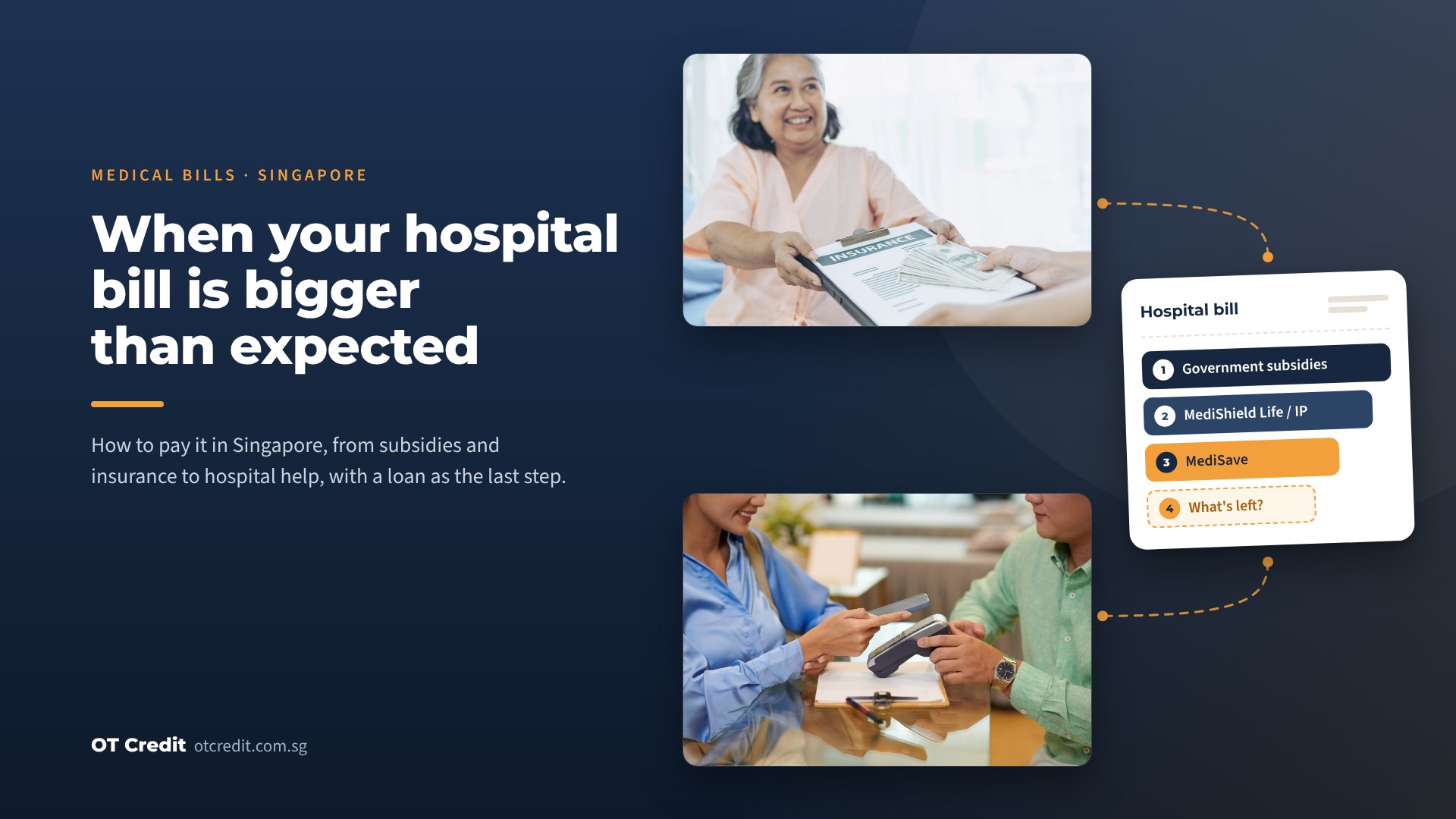
A hospital bill in Singapore has usually been cut down a few times before it reaches you. Government subsidies come off first if the stay was in a Class C, B2 or B2+ ward at a public hospital. MediShield Life or an Integrated Shield Plan (IP) pays its share, MediSave can take some of what’s left, and cash covers the rest. When that last line is still too big, a few common assumptions make it feel worse than it is. Here are five worth questioning before anyone reaches for a credit card or a loan. Scheme rules and figures below are as of November 2026.
The insurance will cover it
Often it covers less than people expect, usually for one of three reasons.
The first is the ward. MediShield Life covers every Singapore Citizen and PR, including people with pre-existing conditions, but its benefits are sized for subsidised treatment in Class B2 and C wards. Choose an A or B1 ward, or a private hospital, and you’re still covered. The payout just covers a smaller share of the bill, and it has claim limits on top.
The second is the deductible. An IP adds private cover on top of MediShield Life for higher ward classes and private hospitals, and every claim starts with a deductible that you pay before the plan does. Riders used to be allowed to cover it. Riders sold from 1 April 2026 can’t cover MOH’s minimum IP deductible, and the minimum 5% co-payment on riders hasn’t changed. If your rider was bought after that date, this could be why your share is bigger than you expected.
MOH’s minimum IP deductibles (figures as at November 2025, the latest MOH has published)
| Ward class or type of stay | Minimum deductible |
|---|---|
| Class A ward or private hospital | S$3,500 |
| Class B1 ward | S$2,500 |
| Class B2 ward | S$2,000 |
| Class C ward | S$1,500 |
| Day surgery or short stay, non-subsidised | S$2,000 |
| Day surgery or short stay, subsidised | S$1,500 |
If you stayed in a lower ward class than your plan targets, the lower deductible applies. MOH says these minimums may be updated from time to time.
The third reason is plainer: some items or expenses aren’t covered under the policy or its claim limits. Ask the billing office to go through anything you don’t recognise before you pay.
It all has to come out of my own MediSave
It doesn’t. MediSave can pay hospital and day-surgery bills for approved family members: a spouse, parent, grandparent, sibling or child. They can be any nationality, except grandparents and siblings, who must be Citizens or PRs. You can also draw on more than one family member’s account for the same stay. Each person whose MediSave is used has to authorise it on an MCAF form.
What extra accounts can’t do is raise the ceiling. CPF applies the withdrawal limits per hospital stay, however many people are paying. For inpatient hospital charges (ward, treatment, tests and medicines), the limit is S$1,130 a day for the first two days and S$400 a day after that. Day surgery hospital charges are capped at S$830 a day. The operation itself has a separate limit of S$240 to S$5,290, depending on how complex it is. Anything above those limits is paid in cash.
So a sibling’s MediSave helps when your own account is running low. It won’t help once the bill has gone past the limit.
MediFund is for anyone who can’t pay
MediFund is MOH’s safety net for people who still can’t manage a bill after Government subsidies, insurance and MediSave. To qualify, you have to be a Singapore Citizen and a subsidised patient, treated at a MediFund-approved institution. PRs and foreigners can’t apply. If you’re on a work pass, MediShield Life doesn’t cover you either, so whatever insurance you hold and the hospital’s own payment terms carry most of the weight.
Whatever your status, the person to ask for is a Medical Social Worker. You or your family can approach one at a MediFund-approved institution, and MOH says they’ll also look at other ways to finance the bill if you’re struggling. While you’re at it, ask the billing office whether the balance can be paid in instalments. Whether it can depends on the hospital, but asking costs nothing.
A loan is the obvious fix
Sometimes a loan is needed, but it belongs at the end of the list. Try everything above first, and borrow only an amount you can repay from your income. A personal loan from a licensed moneylender is one option. Whether you’re approved, and for how much, depends on the lender’s assessment of your income, existing loans, and repayment ability.
Two details matter more with medical bills. If you’re covering a parent’s bill, the loan is in your name and judged on your income, not theirs. If you’re the patient, time off work can lower the income a lender looks at, and that can affect approval and the amount.
Borrowing limits, fee caps and how to check a lender’s licence are all in our guide to what licensed moneylenders can and can’t do in Singapore.
Once the money’s paid out, I’m stuck with it
Not if it’s an unsecured personal loan paid out on or after 15 September 2026. Those loans, other than business loans, now come with a three-business-day cooling-off period. MinLaw brought it in so that borrowers can rethink a credit decision that may have been made on impulse. A hospital bill landing on the kitchen table is the kind of moment it was made for.
The three days start after the day the money is paid out, and weekends and public holidays don’t count. So a loan paid out on a Friday can be cancelled on the Monday, Tuesday or Wednesday, provided none of them is a public holiday.
If you cancel in time, there’s no interest. You repay what you actually received, plus part of the approval fee at most. For loans of S$5,000 or less, the lender can keep up to S$50 of that fee. Above S$5,000, it can keep up to 3.5% of the principal. It can never keep more than the fee you paid, and the total you repay can’t be more than the amount you borrowed.
Here’s how that plays out. Say you borrow S$2,000 to clear the hospital balance, and the lender deducts a S$200 approval fee (the 10% maximum), so S$1,800 reaches you. Two days later, your brother says he’ll cover the bill himself. If you cancel within the window, the most you’d repay is S$1,850: the S$1,800 you received plus up to S$50 of the fee.
The lender must let you cancel if you meet the requirements, and a refusal can be reported to the Registry of Moneylenders. The Registry’s FAQ doesn’t say how notice has to be given, so ask the lender before you sign how you’d cancel, and keep a record of when you told them. Let the three days pass, and the loan simply continues on its original terms.
Recovery takes time, and so does income. If you, or the person you’re caring for, will be off work for a while, plan repayments around what will actually come in over the next few months, not last year’s payslips. If the only way to make a repayment would be another loan, speak to a Medical Social Worker before you borrow anything.
Before the next admission
If the next stay is planned, ask the doctor or hospital for the expected range of fees and a breakdown before you’re admitted. For a private hospital admission or day surgery, MOH also suggests asking for the Table of Surgical Procedures (TOSP) code or provisional diagnosis, which lets you check the quote against MOH’s published fee benchmarks.
Get your IP policy out now rather than at the billing counter. Check which ward class it’s built for, which deductible applies, and when your rider was bought. And if you can, put a little aside each month, so the next unexpected bill doesn’t have to involve borrowing.
Whoever you borrow from, look them up first on the Ministry of Law’s list of licensed moneylenders.
Speaking to OT Credit
If you’ve been through the hospital’s options and there’s still a gap, we’ll show you what a loan would cost each month and how the cooling-off period works, before you sign anything. Any loan depends on our assessment of your income, existing loans, and repayment ability.
OT CREDIT PTE. LTD.<br> Licensed by the Ministry of Law’s Registrar of Moneylenders (Licence No. 101/2026)<br> 135, JURONG GATEWAY ROAD, #01-323, SINGAPORE 600135<br> 62920119
Related reading
- From 15 September, You Get Three Days to Change Your Mind About a Moneylender Loan
- What Licensed Moneylenders Can & Can’t Do in Singapore
- Can Work Pass Holders Get a Loan in Singapore?
Sources
- Ministry of Health: MediShield Life
- Ministry of Health: About Integrated Shield Plans
- Ministry of Health: New Requirements for Integrated Shield Plan Riders
- Ministry of Health: Hospital stays
- Ministry of Health: Managing medical bills
- Ministry of Health: MediFund
- Ministry of Health: MediSave
- Ministry of Health: Hospital Bills and Fee Benchmarks
- CPF Board: Using MediSave for hospitalisation
- CPF Board: Can I use more than one of my immediate family member’s MediSave for my hospitalisation expenses?
- Registry of Moneylenders, Ministry of Law: FAQs on Borrowing From Licensed Moneylenders
- Ministry of Law: Mandatory Cooling-off Period for Loans Taken from Licensed Moneylenders
- Registry of Moneylenders: List of Licensed Moneylenders in Singapore