
Singapore’s New Mandatory Cooling-Off Period for Licensed Moneylender Loans
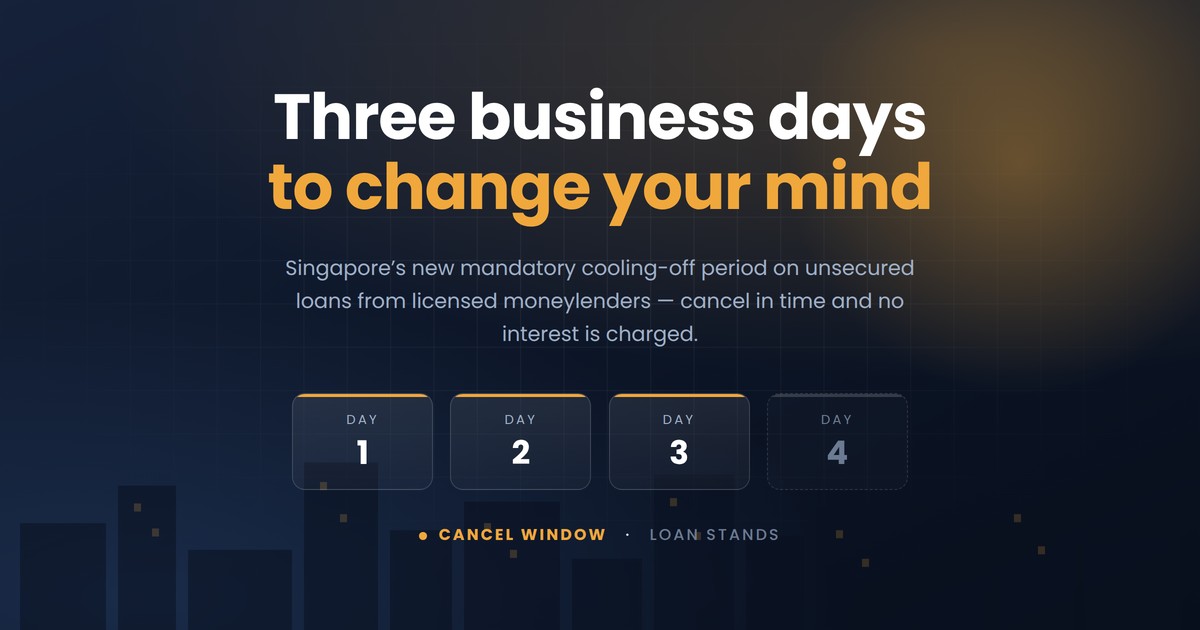
Singapore’s new mandatory cooling-off period lets you cancel an unsecured loan from a licensed moneylender within three business days — and caps what the lender is allowed to keep if you do. Here is what it covers, what canceling actually costs, and where the rule stops.
01
What changed today
Signing a loan agreement in Singapore used to be close to a one-way door. Change your mind the next morning and the moneylender was entitled to hold on to the entire loan approval fee, plus any interest that had already accrued — so a decision made under pressure on Monday was still costing you on Tuesday.
From today, that door swings both ways. The Ministry of Law (“MinLaw”) has made a cooling-off period of three business days compulsory on every unsecured loan taken from a licensed moneylender, with one carve-out: business loans. Inside that window, you may cancel the loan and hand the money back at a sharply reduced cost.
“Three business days” is counted the way you would hope. Saturdays, Sundays and Singapore public holidays are left out, so a loan signed on a Thursday still leaves you with Friday, Monday and Tuesday to reconsider — a genuine long weekend to think, not a technicality that expires before the working week restarts.
02
What canceling costs you
The cooling-off period is not a free trial, and it was never designed to be. A lender still does real work to approve a loan — identity checks, income verification, the credit assessment — and the rule lets it recover a capped part of that cost through the loan approval fee it charged you.
| PRINCIPAL OF THE UNSECURED LOAN (NON-BUSINESS) | MOST THE LENDER MAY RETAIN IF YOU CANCEL |
|---|---|
| $5,000 or less | $50, and never more than the loan approval fee charged |
| More than $5,000 | 3.5% of the loan principal, and never more than the loan approval fee charged |
Two things about that table are worth slowing down for.
First, both figures are ceilings, not prices. If the approval fee you were charged was smaller than the cap, the smaller number is what the lender keeps.
Second, the loan approval fee in Singapore is already capped at 10% of the principal under the money-lending rules — which means the 3.5% ceiling genuinely bites on larger loans, cutting the cost of a change of mind to roughly a third of what the fee would otherwise have been.
The arithmetic of a cancellation is simple enough to do on the back of a receipt. You repay the cash that actually reached you — the principal minus the approval fee that was deducted upfront — plus the capped portion of that fee the lender is allowed to keep. No interest is charged for the days you held the money, and the total you hand back can never exceed the principal amount of the loan.
03
Two worked examples
A 10% approval fee leaves $900 deducted upfront and $900 in your hands.
$900
$50
$950
$50
The same 10% fee means $1,000 deducted and $9,000 disbursed; above $5,000, the cap is 3.5%.
$9,000
$350
$9,350
$650
The second illustration is our own working of the rule, not an example published by MinLaw.
04
Where the rule stops
05
Why MinLaw brought it in
MinLaw built the framework in consultation with the Credit Association of Singapore, the professional association representing licensed moneylenders, and the balance it was aiming for is stated plainly: give borrowers room to reconsider credit decisions that are sometimes made on impulse, while making sure lenders are still compensated for the work of granting a loan.
The start date was not accidental either. MinLaw set commencement at 15 September 2026 to give licensed moneylenders time to adjust their processes and systems, with the Registry of Moneylenders working alongside the industry on implementation.
06
The other change most borrowers missed
Earlier this year, in April 2026, the Registry also updated its Professional Service Handbook for licensed moneylenders with three practices it encourages the industry to adopt:
- Rewards for paying well — discounts or rebates on interest and fees for borrowers who repay on time or settle ahead of schedule.
- Digital touch-points — tools such as an online portal where you can watch your own loan servicing rather than phoning to ask.
- Real help for borrowers in difficulty — restructuring a repayment schedule to something a struggling borrower can actually meet, or referring them to a Social Service Agency.
These are encouraged best practices rather than legal obligations, which makes them a fair question to put to any lender before you borrow: do you do these things?
07
How to be sure you are at a licensed lender
The cooling-off period only protects you if the lender is licensed, so check before anything is signed. Licensed moneylenders are listed on the Registry of Moneylenders on MinLaw’s website.
Borrowing with OT Credit
At our Jurong East office, nothing about this changes how we work — it simply writes into law what a careful loan conversation should already look like. We will tell you what the loan costs before you sign, when your three business days end, and exactly what you would repay if you decided to walk away. If that conversation makes you want to wait, wait.
Frequently asked questions
⌃
⌄
⌄
⌄
⌄
⌄
⌄
⌄
⌄
⌄
Source: Ministry of Law, “Mandatory Cooling-off Period for Loans Taken from Licensed Moneylenders”, 31 August 2026 (mlaw.gov.sg).
This article is general information about a regulatory change, not financial or legal advice. For the terms that apply to your own loan, speak to us before you sign.